Episode 1 · 13:17 video · 9 min read
What If the Internet Shut Down Forever?
What would really happen if the internet shut down forever? Follow Tik and Byte from minute 1 to 100 years later: frozen cards, empty shelves, paper hospitals, the return of radio and a digital dark age.
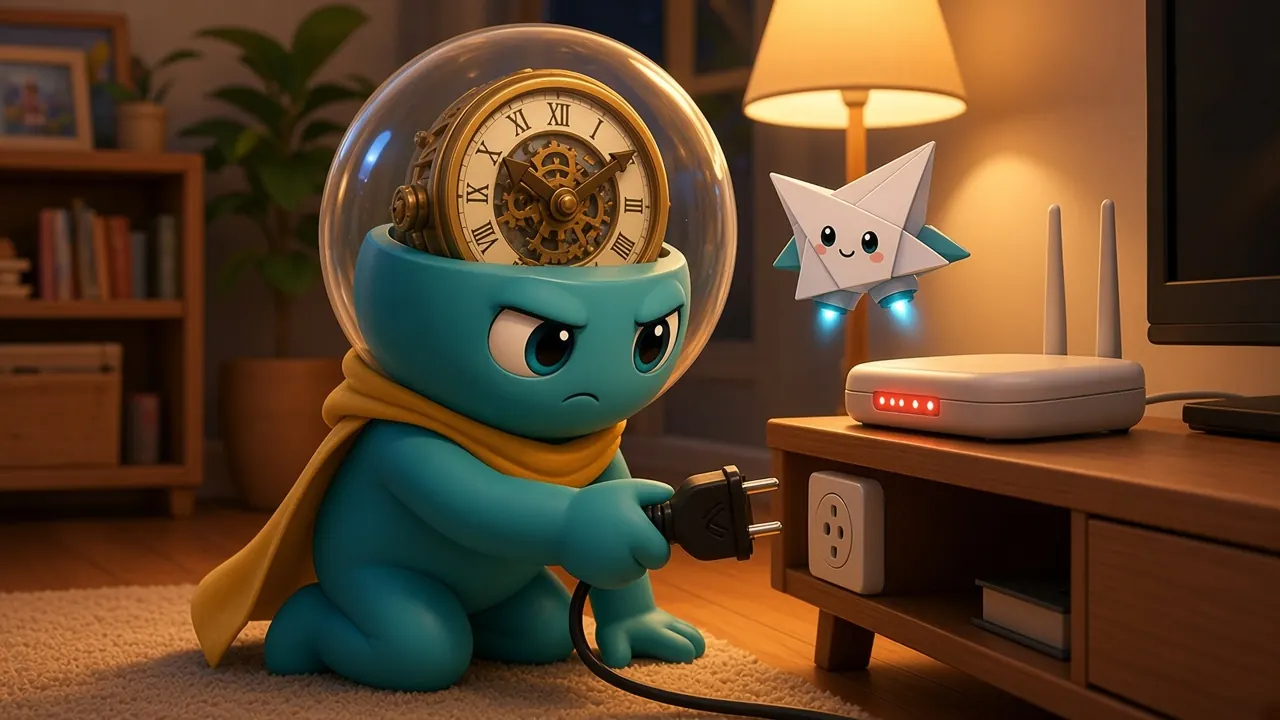
It's 9:14 on a Monday morning. The toast is almost ready, the phone is buzzing with a group chat, and someone has just sent a video of a goat in pyjamas. Then the goat freezes. The little loading wheel starts to spin. And it never stops.
That is the starting point for our first adventure with Tik and Byte. In this thought experiment it isn't only your Wi-Fi that dies. Every network on Earth that speaks the internet's language goes quiet at the same moment: public, private and satellite. And there is one rule. It never comes back. You can reboot the router as often as you like; every attempt to reconnect, anywhere, fails.
So what actually happens next? Let's jump forward, step by step, from the first minute to a hundred years later.
Minute 1: the biggest silence on Earth
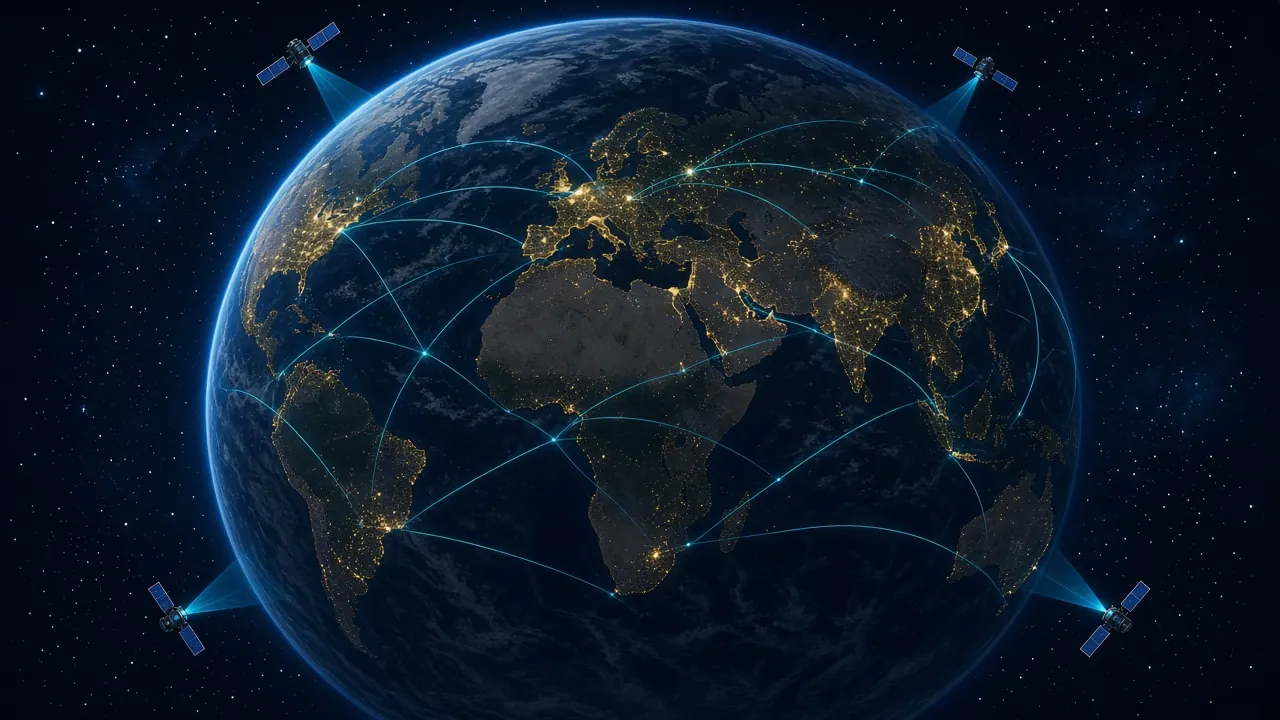
To understand the shutdown, it helps to picture what the internet really is. It isn't a cloud. It's a cable. More than 500 undersea cables lie on the ocean floor, roughly 1.4 million kilometres of them, enough to wrap around the planet about 35 times. They carry almost all of the data that moves between continents. Satellites handle only a small slice.
In our scenario those cables are perfectly fine. Nothing is cut and nothing is broken. They simply have nothing left to say.
Around six billion people use the internet, and in the first minute almost all of them do the same thing: they switch it off and on again. It doesn't help, but it was worth a try. Next, people try to call someone, and that fails too. Today most mobile networks, and much of the landline system, carry voice calls using internet technology, so under our rule your phone can't even ring.
Hour 1: your money still exists, but nobody can move it

The first thing most people notice isn't the missing videos. It's the card reader blinking red. That quick tap at the checkout sends a message to your bank and back in about a second, and Visa alone processes hundreds of millions of those every day. Without a network, the card in your pocket becomes a nicely designed piece of plastic.
Some shops can store a few payments offline and settle them later, but "later" never arrives. Within the hour, the hand-written "CASH ONLY" signs go up. That's a problem, because in many countries cash is now a small fraction of everyday spending, and most people carry very little. ATMs need the network too, so you can't take out more.
Stock exchanges stop trading. Banks can't send money to each other. Salaries, savings and rent are all numbers on computers that can no longer talk. Your money still exists. Nobody can move it.
What happens to planes?
Here's some good news: planes don't need the internet to fly. Pilots talk to air traffic control over radio, and radar works on its own, so every aircraft already in the air lands safely.

Almost nothing new takes off, though. Flight planning, crew rosters, weather data, bookings and check-in all run on networks. We had a small preview in January 2023, when one US system that warns pilots about hazards failed and departures across the country were held on the ground. Now imagine that happening to every system, everywhere, forever.
Day 1: the supermarket shelves
How much food is in the back room of your local supermarket? Usually just a few days' worth. Each time a barcode beeps at the checkout, a computer quietly orders a replacement. Trucks are dispatched, routes are planned and warehouses restocked, all automatically. It's a gigantic, invisible conveyor belt, and today it stopped.
The trucks still run and the drivers are ready, but they don't know where to go, what to carry or who's paying. Once shoppers realise this, shelves empty much faster than a few days. Your smart fridge still keeps things cold, by the way. It just can't send you notifications about it any more.
Do the lights go out?
Mostly, no. Power stations don't need the internet to spin. Grid control systems are meant to be walled off from it anyway, and operators train for days when their screens go blank. Under our rule their private networks fail as well, so engineers fall back to running the grid by hand, with whiteboards and radio handsets. Coordination gets clumsy and blackouts become more common. It's not a planet going dark. It's a planet flickering.
Week 1: hospitals return to paper and pencils

Hospitals already have a plan for this. It's called downtime, and it means paper: paper charts, paper orders, and runners carrying test results from floor to floor. We know how it goes because it has happened on a smaller scale. When hospitals have been hit by cyberattacks, some had to divert ambulances and work on pen and paper for weeks.
Surgeons can still operate and doctors still remember medicine. But your medical history now lives on a server nobody can reach. Prescriptions, allergies and scans are gone unless someone printed them.
The bigger worry is the medicine supply. Many drugs are made on one continent, packaged on another and shipped to a third, and every step was booked, tracked and paid for online. Around 80% of the world's goods by volume travel by sea, and every container has a digital file saying what's inside and where it's going. Now ships arrive at ports full of identical metal boxes that nobody can identify. Imagine opening ten thousand mystery containers to find the one with insulin. (One of them is full of rubber ducks.)
Petrol stations have the same problem: pumps want cards, and fuel deliveries are scheduled by software. Tap water mostly keeps flowing, because treatment plants can be run by hand, but they need regular chemical deliveries, and arranging one now involves a lot of shouting.
Does GPS still work?

Half yes. GPS satellites don't use the internet at all. They broadcast a time signal, and your phone uses it to work out where you are. So your phone still knows exactly where you are, but unless you downloaded maps beforehand, it has no idea what's around you. You become a blue dot in a grey void. Very philosophical. Not very useful.
Month 1: the old machine wakes up
A month in, the shock wears off and something unexpected happens: people start talking to each other again, out loud and in person. Town noticeboards fill up with hand-written notes such as "LOST CAT", "WILL TRADE EGGS FOR BATTERIES" and "SCHOOL OPEN TUESDAY".
Remember the century-old machine that's probably a few metres from you right now? It's the radio.

Broadcast radio doesn't need the internet. A tower sends a signal through the air, and any receiver in range picks it up, for free. Marconi sent the first radio signal across the Atlantic in 1901, and more than a century later it becomes the way governments tell people where to find food, water and medicine.
Then there are the amateur (ham) radio operators, people who have spent years chatting with strangers in distant countries just for fun. After hurricanes and earthquakes they've often been the ones relaying messages when everything else was down. Overnight, the hobby everyone teased them about becomes essential infrastructure.
Year 1: a slower, paper-powered world
A year after the silence, the world looks slower. Shops that survived run on cash, paper ledgers and trust. Some towns print their own local vouchers, and barter is back, awkwardly, because nobody knows how many eggs a haircut is worth.
Jobs shuffle too. Hundreds of millions of people worked mostly on computers, and some of that work simply disappears. But a paper world is hungry for people: clerks to keep ledgers, couriers to carry them, and teachers who can explain long division without a calculator app.

Letters return in a big way. Post offices that had been shrinking for years are suddenly overwhelmed, and the fastest way to send a message across an ocean is by ship, or by plane once flights are planned on paper again.
Who loses? Anyone whose job existed only on a screen: online shops, ride apps and influencers. On the bright side, so does every scammer, spammer and ransomware gang on the planet. Who wins? Local farmers, bike repair shops, paper map makers, libraries (now the only place to look something up) and, above all, radio.
10 years: the slow network
Ten years in, humanity has done what it always does: it improvises. The rule says nobody can rebuild the internet, but engineers can still build simpler systems that don't speak its language, such as dedicated radio links, old-fashioned telephone switching and machines that send text a few lines at a time. Sending one photo takes an afternoon. Kids who grew up after the silence don't mind, because they've never known anything faster.
Some things are genuinely better. People sleep more. Town centres are busy again because that's where the news is. Where screens and billboards went dark, a few more people can see the Milky Way. Other things are harder. Medicine has stepped backwards, research travels by post, and supply chains have shrunk to regional ones, so you eat what grows nearby. In winter, that means a lot of cabbage.
In classrooms, a phone sits in a glass case like a museum piece. One kid asks what "buffering" means. Nobody wants to explain.
100 years: the digital dark age

A century later, the giant data centres that once stored our photos and messages are quiet, ivy-covered warehouses full of dust. Here's the twist almost nobody expects: future historians may know less about the early 2000s than about the 1800s.
Internet pioneer Vint Cerf warned about this and called it a digital dark age. Data on hard drives and memory chips doesn't last forever, and when it's left unpowered and unread for decades, much of it slowly fades. A hand-written letter in a shoebox can survive for centuries. The billions of photos we took are mostly gone, while the handful someone printed are still on the fridge.
In museums, our era becomes a strange, short chapter: "The Connected Age", when billions of people talked all day, to everyone at once, and left surprisingly little behind. And those 1.4 million kilometres of cable on the ocean floor? They're still there, silent and crusted with coral: the longest reef humans never meant to build.
What it really means
Rewind to 9:14 that Monday morning. In one minute the screens froze. In one hour money stopped moving. In a day the shelves began to empty. In a week hospitals picked up their pens. In a month we turned on the radio. And in a year we learned our neighbours' names.
We like to think the internet connected machines. It didn't. Every message, every payment, and every video of a goat in pyjamas was one person reaching for another; the wires just made it fast. Take the wires away and the reaching doesn't stop. It just gets slower, louder and a lot closer to home.
Your turn: if the internet shut down tomorrow, what's the one thing you'd miss most? Tell us in the YouTube comments, while we still have them.
Frequently asked questions
Could the whole internet really shut down at once?
It is extremely unlikely. The internet has no single off switch: it is thousands of independent networks linked by more than 500 undersea cables, satellites and data centres. Large regional outages do happen, but a permanent worldwide shutdown is a thought experiment, which is exactly why it is fun to explore.
Would planes fall out of the sky if the internet went down?
No. Aircraft already in the air talk to air traffic control by radio, and radar works without the internet, so they would land safely. The problem is on the ground: flight planning, crew schedules, weather data and check-in all run on networks, so very few new flights would take off.
Would my money disappear if the internet stopped?
Your money would still exist, but you could hardly move it. Card payments, bank transfers and ATMs all depend on networks, so within an hour most people could only spend the cash in their pocket, and in many countries that is very little.
Would the power go out without the internet?
Mostly not. Power stations do not need the internet to spin, and grid operators train to run the grid by hand. Coordination would get clumsier, so expect more frequent local blackouts, but not a planet going dark.
Does GPS work without the internet?
Yes. GPS satellites broadcast a time signal that your phone uses to work out its position, with no internet involved. But unless you downloaded maps beforehand, you would see a blue dot on a blank grey screen.
What would replace the internet for news and emergencies?
Broadcast radio. A transmitter sends a signal through the air and any receiver in range can pick it up for free. Governments would use it for food, water and medicine updates, and amateur (ham) radio operators would relay messages, as they have after hurricanes and earthquakes.
What is the digital dark age?
It is a phrase popularised by internet pioneer Vint Cerf for the risk that future historians lose access to our digital records, because data on drives and memory chips can fade or become unreadable, while paper letters can last for centuries.
New "What If?" videos with Tik & Byte.